
We spend roughly two-thirds of our lives upright. We eat, work, hold our children, and breathe in this position. And yet for the entirety of modern radiation oncology, we have asked patients to do the one thing their bodies are least accustomed to: lie still and flat, often for fifteen to thirty minutes at a time, while a multi-ton gantry orbits around them.
The reason has been engineering, not clinical. It is much easier to deliver a steady photon or proton beam from a fixed direction and rotate the patient's environment to meet it. So we built rooms and gantries to do exactly that. The clinical and financial cost of that decision, however, has grown to the point where it is now worth re-examining the assumption itself.
Companies like Leo Cancer Care are doing exactly that. Their thesis is simple: rotate the lighter object. A 100 lb patient can be rotated more accurately, more cheaply, and more comfortably than a 100-ton gantry. The implications for radiation oncology, and specifically for proton therapy, are profound.
"If you need to change a lightbulb, you don't hold the bulb and rotate the house."
Leo Cancer Care, on the case for upright treatment
Anatomy was never meant to be supine.
A growing body of imaging research, much of it summarized on Leo Cancer Care's "Why Upright" page, is making the clinical case more precise than the intuition.
Lung
MD Anderson imaging shows upright lung volume is on average 25% larger, in some cases up to 50% larger, with reduced breathing motion. That is a direct invitation to tighten margins on thoracic tumors.
Breast
Boisbouvier et al. (2023) found upright breast positioning to be feasible, comfortable, and likely to improve cardiac and lung sparing, the two endpoints that have driven a generation of breast RT innovation.
Liver
Paul Scherrer Institute work showed the liver can drift and deform up to 20 mm over 35 minutes when a patient lies down. Upright imaging produced a far more stable liver and fewer respiratory-gating errors.
Prostate and pelvis
Schreuder et al. (2023) reported that upright stabilizes the prostate and seminal vesicles and is less affected by bladder fill, two of the largest sources of supine setup error.
Head and neck
Alghadir et al. (2017) found difficulty swallowing was 6× higher supine. Upright reduces aspiration risk and the anxiety that drives motion in the first place.
Together, these indications represent more than 70% of all radiation therapy cases. The takeaway is not that supine is wrong, it is that the supine assumption is no longer the default we should defend without evidence.
A modality strangled by its own architecture.
This is where the upright argument becomes most consequential. Proton therapy, more than any other modality, has been defined by the gantry.
A modern multi-room proton center is built around a cyclotron or synchrotron the size of a small house, beamline optics that route the beam to multiple rooms, and a rotating gantry per room that can weigh upward of 100 tons. Each gantry sits inside a vault with concrete shielding 14 feet thick. The result is a building, not a treatment room, with capital costs that routinely exceed $200M for a multi-room facility.
We have written elsewhere about how that capital structure has bankrupted a meaningful share of the first generation of US proton centers. The honest read is that proton therapy is not failing because protons are unhelpful, the Bragg peak is real, the dosimetric advantages are real, the pediatric and re-irradiation cases are not in serious dispute. It is failing because the building required to deliver protons under the supine, rotating-gantry paradigm is too expensive for the catchment areas most centers can realistically serve.
Upright RT attacks that constraint at its root.
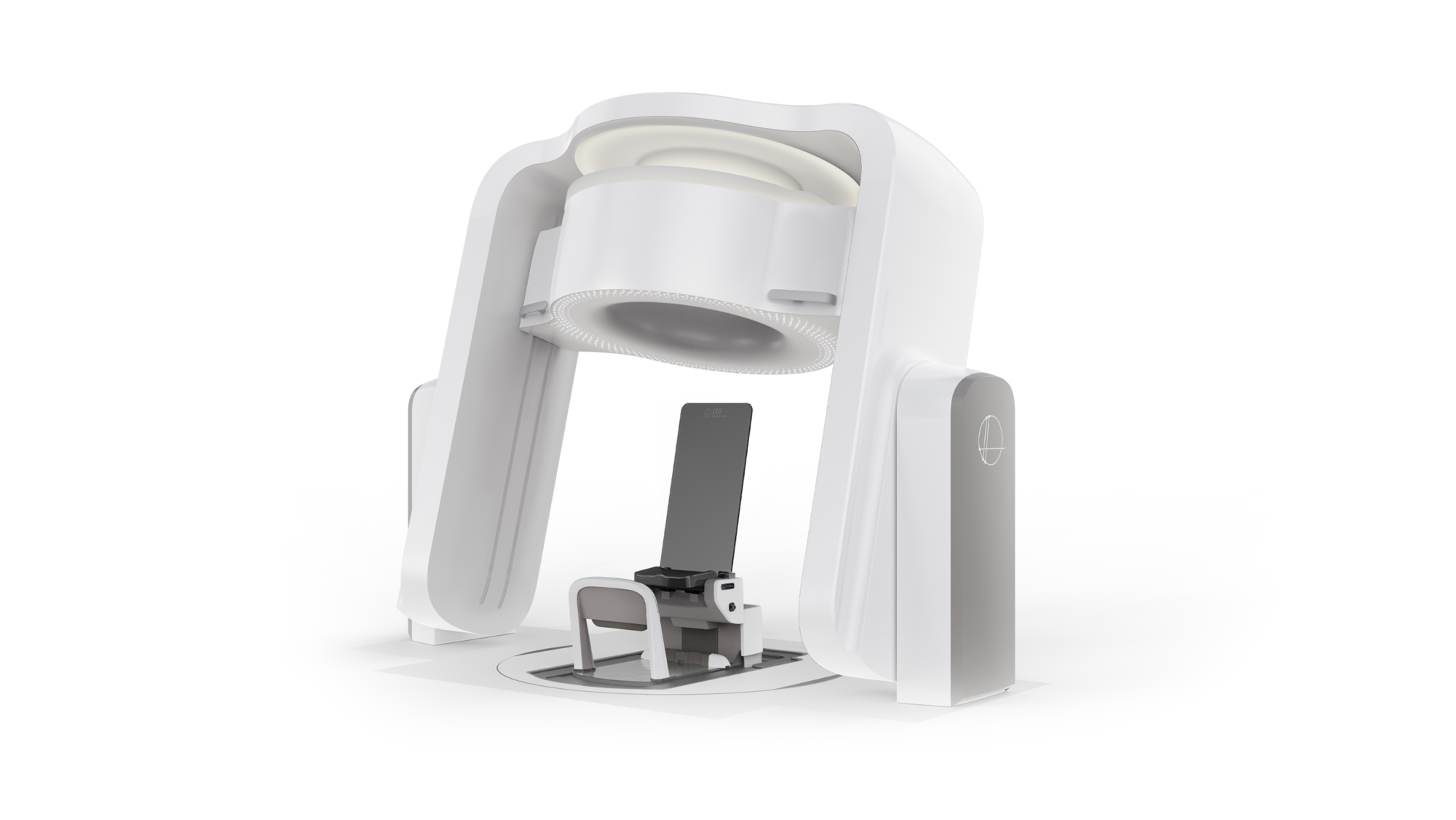
Proton therapy that fits inside a LINAC vault.
The Marie particle therapy solution from Leo Cancer Care is designed around a fixed beam and a slowly rotating upright patient. Removing the rotating gantry collapses the treatment room footprint dramatically. The system is small enough to be installed inside an existing LINAC vault.
That single architectural change cascades through the entire economic model:
For a community oncology practice, this is the difference between proton therapy as an unreachable academic project and proton therapy as a viable line item in a regional capital plan. For a health system that already operates LINACs, it is the difference between a $200M decision and something materially closer to a conventional radiation oncology investment.
This is what Leo Cancer Care means when they talk about "democratizing proton therapy." The point is not marketing language, it is that the modality has been geographically rationed by its building, and the building is no longer required.
One room. Simulate, image, treat.
Upright also dissolves the artificial split between the CT-sim suite and the treatment vault. Leo's upright fan-beam CT scanner sits at the isocenter of the treatment room. Patients are simulated, imaged daily, and treated in the same upright posture, in the same room.
That is the real precondition for online adaptive proton therapy. Protons are exquisitely sensitive to anatomical change, weight loss, tumor shrinkage, day-to-day filling of the bowel or bladder, and re-planning workflows have been the operational bottleneck for years. An integrated upright CT at isocenter, with a positioning system that is the same device patients are treated on, is the most direct path to adaptive proton therapy that scales beyond a handful of research sites.
Eye to eye, not flat on a slab.
It is easy to roll our eyes at "patient experience" claims in oncology marketing. They are usually a softener for a decision that was made for other reasons. Upright RT is the rare case where the patient experience argument and the clinical and economic arguments point the same direction.
Upright treatment lets the radiation therapist work eye to eye with the patient. It removes the claustrophobia of being slid into a bore. For patients with back pain, dyspnea, anxiety, or limited mobility, it is dramatically more comfortable. Patient preference studies referenced by Leo Cancer Care show the majority of patients prefer upright over supine when given a choice.
Pediatrics is where this matters most. Children naturally live upright. Upright workflows are compatible with general anesthesia where required, but they also open the door to gamified, distraction-friendly environments that reduce or eliminate the need for daily anesthesia in older pediatric patients. The downstream implications for sedation complications, throughput, and parent experience in a pediatric proton program are substantial.
What we are watching.
Upright RT is not yet commercially live at scale, and the clinical literature is still maturing. Three things deserve honest scrutiny:
First-patient evidence on the actual systems
Most of the supportive research was conducted on legacy upright setups or with imaging cohorts. Leo Cancer Care has been transparent that they have multiple systems going live in 2026 and that early studies will need to be revalidated on their own platforms.
Workflow change management
Treatment planning, dosimetry, and QA workflows are mature in the supine paradigm. Partnerships with RaySearch and others are closing the gap, but adopting centers should plan for a real change-management investment.
Reimbursement and CON pathways
Smaller, cheaper proton rooms are good for patients and capital efficiency. They will also be a new conversation with payers and certificate-of-need authorities used to evaluating proton centers as $200M monoliths.
None of this changes the direction of the argument. It just describes the work between here and the future state.
The future is the lighter object.
Look at the long arc of radiation oncology and the pattern is consistent. We win when the modality conforms to the patient. IMRT was a step. SBRT was a step. Pencil-beam scanning was a step. Each one tightened the dose around the tumor and spared more healthy tissue, and each one was at first met with skepticism about whether the workflow could be made practical.
Upright RT is the next step in that arc, and the first one in a long time that also reshapes the building. For photons, it is a meaningful improvement. For protons, it is the difference between a modality that serves a privileged few academic catchments and a modality that can actually be deployed at the scale the clinical evidence warrants.
The investors, health systems, and physician groups thinking about radiation oncology over the next decade should plan accordingly. The proton centers that will define the next ten years are unlikely to look like the proton centers that defined the last ten.
Sources and further reading: Leo Cancer Care's Why Upright and Particle Therapy pages, plus underlying peer-reviewed work from MD Anderson, Paul Scherrer Institute, Centre Léon Bérard, and Sheffield Hallam University. Oncology Executive Advisors has no commercial relationship with Leo Cancer Care; this post reflects our own operator view of where radiation oncology is heading.